Dana Corby is widely considered to be the person responsible for popularizing what she called the Witches’ Runes. She wrote about them in a journal named Crystal Well, sometime in the 1970’s. The limited publication of this journal, along with the distance of time, has made it inaccessible for my research. Questions concerning this article include: how many runes Corby wrote about; what were their symbols; what names did she give them; and did she propose a method of divination for their use. Years after the publication of this article, Corby wrote a book titled The Witches’ Runes, published by The Rantin’ Raven in 1993. In this book she presents a series of 14 ‘Runestones’, stating that they were given to her in 1972 by her American teacher Lady Sara (Sara Cunningham). Cunningham died in 2016, well after the publication of Corby’s book, and there is no record of her contradicting the attribution. Whether Cunningham was the creator of these runes and their system of use or was taught them by someone else remains unclear, although Corby’s book states:
“…the Runestones, like the Witches who secretly passed them down through the generations, disappeared from view until the repeal of the last Witchcraft Act in1951 made it safe for British Witches to step out of the broom closet”
It is clear from this statement that Corby believes them to be of a more ancient origin. Her book goes on to discuss the presence of Runestones in Britain, which are stone monuments carves with various hieroglyphs. She draws a relationship between these stones and a practice of marking smaller stones with similar runic symbols, that she believes were used by ancient witches to tell fortunes. Unfortunately this is mere supposition, as there are no scholarly examples to back up the claim that Runestones evolved into an ancient form of casting smaller inscribed stones. Though sortilege is known to have existed in ancient cultures, there is no documentation of objects inscribed with runes having been employed for this purpose. Cultural exoticism attributed to ancient Celtic practices informs many neo-pagan beliefs, especially among white practitioners in North America longing for a sense of heritage, and it is all too common to see modern practices depicted as originating from ancient Celtic culture, a fact that makes such claims suspect.
Corby’s set of Witches Runes are a mixture of Elder Futhark and symbols of unknown origin. They are as follows:
Man
Woman
Love
Family
The Home
Gifts
Money
Possessions
Poison
Disordered Thoughts
War
Death
Comfort
Fire
It is a well-balanced system, and one that may result in a reading that encompasses many of the concerns and conditions encountered in life.
Corby’s system involves choosing a rune to represent the person to whom the question of the reading pertains, who she refers to as the Querent, using a term popularized by Tarot readers. The runes are cast together for a reading, and those closest to the querent’s rune are emphasized as conditions of immediate regard, as they represent the situations and themes closest to the querent. To represent the Querent she suggests either the Man or Woman rune, and is progressive in her advice that should the Querent not identify as male or female that an additional rune be introduced into the system. She also suggests the addition of a Runestone for reading in which a Querent is a group of people. This is where this system gets a bit unconstrained with the introduction of Querent related runes.
Although she does not refer to them as Witch’s Runes, Patricia Crowther in her book Lid Off The Cauldron, A Wicca Handbook (1981), proposes her own system of runes meant for sortilege. Stating the 8 is the number of the Craft, she proposes a system with as many runes. Each Rune stone is collected out in nature and has an associated color. Each is painted on one side with a given symbol. She does not name each of her runes, but descriptively they are as follows:
Sun, gold
Crescent Moon, silver
2 Interlocking Rings, pink
Crossed Spears, red
Wave, blue
Birds, red and white and blue
Ear of Corn, yellow
H, black stone with white symbol
Cupping all 8 stones in your right hand (either you have giant hands or have hopefully found small stones), you throw them like dice. Stones that land with the painted rune faced down are disregarded. This system does not rely on a rune to represent the querent. The rune that lands farthest away from the caster is most noteworthy, whereas those closest to the reader are given less significance. To me this has always seemed backwards, especially regarding how I personally practice other forms of sortilege such as bone throwing, for which those items that are closest to me are most noteworthy. Unfortunately Crowther does not explain why her system is oriented as it is. Crowther includes several prohibitions and care instructions, but no examples of a reading.
Though unrelated to the Witch’s Runes, I must mention the work of Ralph Blum, who published The Book of Runes in 1982, as his writings popularized using runes for divination. Blum, by a process of asking each runic symbol what its meaning was and apparently by some psychic means receiving an answer, created a system of elder futhark runes, including a blank one indicating mystery, making a total of 25. Inspired by his study of the I Ching, Blum utilized the runes for fortune telling. Though he is criticized for his unscholarly interpretations, his system was very popular in the early 1980’s, ‘90’s, and continues to be published today. I mention him because a suspect that the popularity of his system inspired others to further develop a runic system for witches, one with less of a Viking vibe than Blum’s.
In 1998 Susan Sheppard published A Witch’s Runes, How to Make and Use Your Own Magick Stones. Sheppard picked a witchy number that spoke more to cultural witchcraft than traditional Wicca, with 13 runes.
In common with Dana Corby’ system, she includes a rune for Man and Woman.
In common with Patricia Crowther, she includes the Sun; Moon; Rings (though Sheppard uses 3 rather than 2); Waves; and Birds (which she names Flight). Appearing similar to the Crossed Swords, Sheppard has two crossed double barbed lines she calls Crossroads. Instead of an Ear of Corn, which is a symbol born in the Americas, we get Harvest, and a strange symbol of a lines and circles standing in a bowl that is meant to represent wheat.
The ominous black H symbol, denoting misfortune and grief, is the only one of Crowther’s to be left out.
In full, Sheppard’s system is as follows:
Sun
Moon
Flight
Rings
Romance
Woman
Man
Harvest
Crossroads
Star
Waves
Scythe
Eye
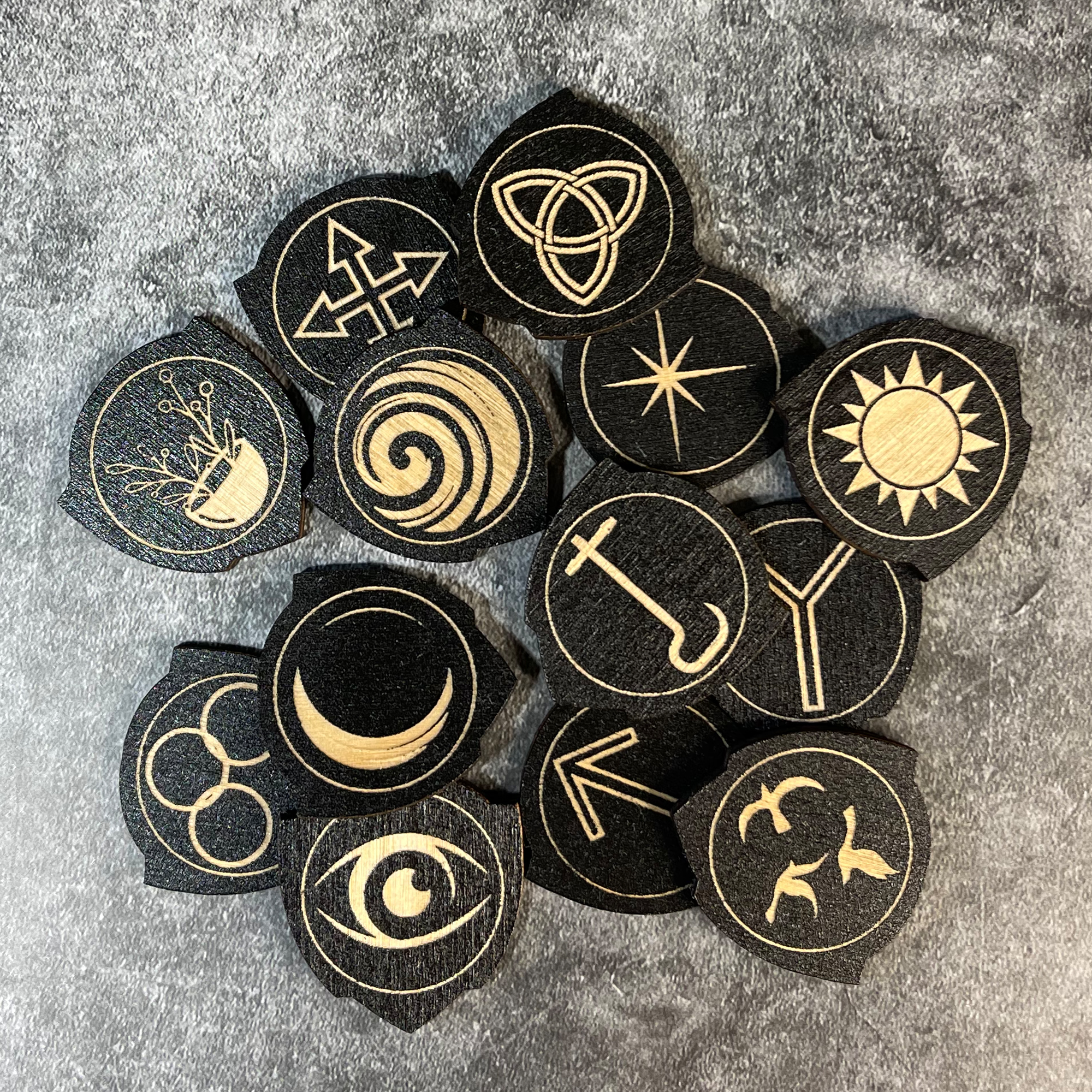
This is the system that I have based my runes on, as it is the best know out of all of them. When searching the internet today for ‘Witch’s Runes’ what I find are several depictions of Sheppard’s system. You can buy illustrations on parchment paper of these same runes, apparently to put in your personal Book of Shadows (a collection of spells and witchy ephemera that many witches choose to craft). Pinterest is also rife with images of these runes and brief descriptions of their meanings.
Sheppard’s book is the most romanticized of them all, as she tries to draw ties between her system and the cultures of Babylonians and ancient Scandinavians, with influences from Gypsies and Picts thrown in for good measure. She talks about how these symbols appear throughout Europe, theorizing about how they may have come to be there; however there is no need for this, as the 13 symbols she speaks of are mere depictions of items seen in the world, with the sole exception of the triquetra form she names Romance. These symbols might just have easily been drawn by any child on the planet.
The notion that these 13 symbols represent the archaic divinatory wisdom of some mystically driven culture does not hold up to simple scrutiny, given how basic and universal they are. Many of these same themes are represented in fortune telling systems we know to have no ancient antecedent, such as Lenormand cards, which share the following: Man, Woman, Sun, Moon, Star, Crossroads, and Sickle (or Scythe).
Sheppard is innovative in how she employs these runes in the various spells she presents in the book, such as for blessing a tree or attaining your heart’s desire. Where I feel her system lacks is in the way the stones are worked with. Rather than being cast and having relationship with one another by proximity, a question is asked, and a rune or 3 are plucked from a bag to serve as the answer. Personally, I like to throw things.
For this reason I enjoy the casting style presented by Dolores Ashcroft Nowicki in An Anthology of Occult Wisdom Volume 2. Her set of 10 runes, which she refers to as Stones O’Leery or Gypsy Runes, differ only slightly from those that Sheppard published 12 years earlier.
Eye
Sun
Moon
Stars
Waves
Grain
Birds
Sickle
Crossed Spears
Rings
Absent from Nowicki’s set are the rune for Romance, as well as those for Man and Woman. Similar to Crowther’s version, Nowicki presents Crossed Spears in place of Crossroads, and Rings numbering 2.
Nowicki’s innovation is in how her system is worked with. The Eye rune serves to represent the querent(s), thus solving the issue of needing extra runes to represent plurality and gender ambiguity. The Eye is placed in the center of the throwing space, and the other runes are cast out around it. This action follows the recitation of the following rhyme:
Stones O’Leery, Stones O’Leery,
Tell me truly, tell me clearly
Give to me an answer true
Show me what I am to do
Let my eye see clear and bright
That I may see my future right.
Any runes that land face down are ignored, and those upright are interpreted according to the distance from the Eye and their relationship to one another.
Minus the cute rhyme, this is how I suggest casting the 13 runes that I have crafted for Carnivalia. To make their relationship to one another more evident, I have substituted the circular shape of stones for a stylized design that tapers to a point, making it easy to tell if runes are pointing towards or away from one another.
In summation, while one cannot rule out the possibility of a long-standing secret tradition involving the use of fortune telling symbols employed by witches, there is no scholarship to suggest that is the case, and runes used by contemporary witches are likely a modern invention as are the systems of divination that accompany them. Just as Ralph Blum was able to invent a system of throwing Norse runes that has no connection to ancient practices, it is likely that the Witch’s Runes were similarly inspired.